Everything changed when Victor Wembanyama's right elbow caught Karl-Anthony Towns' chin in Game 4. The NBA Finals were never the same.
Wembanyama's dangerous elbow during a swim move at the 9:27 mark of the third quarter resulted in a Flagrant 1 penalty and two trips to the free-throw line for Towns with possession. It was a costly play in the immediate term, but the damage to the Spurs' title chances has yet to be seen.
More importantly, the play pushed Wembanyama to the brink of suspension.
Wembanyama's emotions and violent physicality have gotten him in trouble. Wednesday's foul on Towns added another flagrant-foul point to his postseason ledger. A round earlier in the Western Conference finals, Wembanyama, with the same right elbow, connected with Naz Reid's head and was assessed a Flagrant 2 foul, forcing him to be ejected. So now, Wembanyama has three flagrant points heading into Game 5 (8:30 p.m. ET Saturday, ABC).
Under league rules, four flagrant points in one playoff run create an automatic suspension for the following game. That's right, with one more flagrant foul, Wembanyama will be in street clothes for the following game — that is, if the series isn't already over by then. (For those wondering, he'd still be able to finish out the game if it's a Flagrant 1.)
Physicality is an essential part of Wembanyama's game and a principal reason why Game 4 ended the way it did. It's wrong to say the Spurs' epic Game 4 collapse began immediately after halftime. In reality, the Spurs were still getting the looks they wanted, generating paint touches in the opening three possessions of the third quarter and putting the Knicks' defense in a blender.
Wembanyama himself earned a paint touch (missing the layup) and then made a wide-open 3-pointer from the corner off of a Stephon Castle drive with two feet in the paint. Following the string of downhill attacks, the Spurs widened the lead to a game-high 29 points with under 10 minutes to go in the frame. Everything was going the Spurs' way.
And then the elbow happened.
The elbow that sparked the Knicks' comeback
When Wembanyama delivered the elbow that put him one flagrant foul away from an automatic suspension, the Spurs felt an immediate impact. Towns knocked down both free throws and the Knicks promptly went on a 13-0 run. The rest, as they say, is history. The Knicks completed the greatest comeback the Finals stage has ever seen and now hold a 3-1 lead going to San Antonio.
The boneheaded plays in the final moments of Game 4 understandably captured most of the conversation in the aftermath of the Knicks 107-106 win, but the flagrant foul early in the third quarter impacted the game in subtle ways and still looms large.
After that point, Wembanyama wasn't nearly as forceful and effective in getting into the paint. His layup attempt just moments before the elbow to Towns was the only shot he took in the painted area for the rest of the third quarter. In fact, the next time the 7-foot-4 superstar registered a paint touch at all came at the 11:50 mark in the fourth quarter. That's right: 11 minutes of game action went by before Wembanyama got the ball anywhere near the basket. And he played almost the entirety of the third quarter.
The damning result is that the Spurs didn't score a single point in the paint for the entire third quarter, marking the first time this postseason that the Spurs — or any team for that matter — went scoreless in the paint for an entire quarter.
Defensively, Wembanyama wasn't as impactful as the Knicks got just about everything they wanted. The most glaring example of Wembanyama's ineffectiveness came midway through the fourth quarter when Towns drove baseline into the Defensive Player of the Year's chest for a point-blank bucket at the rim. Towns' fearlessness facing Wembanyama is a big reason why he leads all players in this series in plus-minus.
For Wembanyama, a guy who demonstrably pointed at his temple in the first half to taunt the Knicks that he was in their head, the tables have certainly turned. Are the flagrant points now in Wembanyama's head? Is he able to still play with his normal physicality in Game 5 or will he purposely avoid contact?
It's the biggest question that hangs over the series. A Finals suspension for Wembanyama wouldn't be totally unprecedented. Observers will quickly recall that Golden State Warriors forward Draymond Green was suspended for Game 5 of the 2016 Finals after he had accumulated too many flagrant points in that run. The Warriors blew that game without Green — and the series.
The Spurs will need Wembanyama to be otherworldly if they want to make the necessary 3-0 run to win the 2026 Larry O'Brien trophy. Wembanyama has averaged 27.8 points, 10.5 rebounds and 3.3 blocks in his first trip to the NBA Finals, but he'll almost certainly have to reach another level to keep the magical Knicks away from the title.
The physicality data shows Wembanyama's impact
Looking at the underlying physicality data, the odds are not in Wembanyama's favor. At least not if he plays like he did after the flagrant foul at the 9:27 mark.
The aforementioned data comes from Roland Beech, the longtime VP of basketball operations for the Dallas Mavericks and the analytical guru who worked on Rick Carlisle's coaching staff during the 2011 NBA Finals win. Beech vividly remembers the many times when Carlisle would preach the importance of physicality and instruct his players to play with a "hit-first mentality."
Internally, Beech tracked physicality variables that were left out of the box score. How many times did a player initiate contact on a drive? How many times was a player hit to the ground? How many times did a defender cause that knockdown? How many times did a player dive for a loose ball? How many times did a player make a hard cut that maybe others wouldn't make?
During the 2012 preseason, he asked Carlisle and his coaching staffers to fill out questionnaires that helped Beech create his "physicality and playing hard" tracking system that he uses to this day.
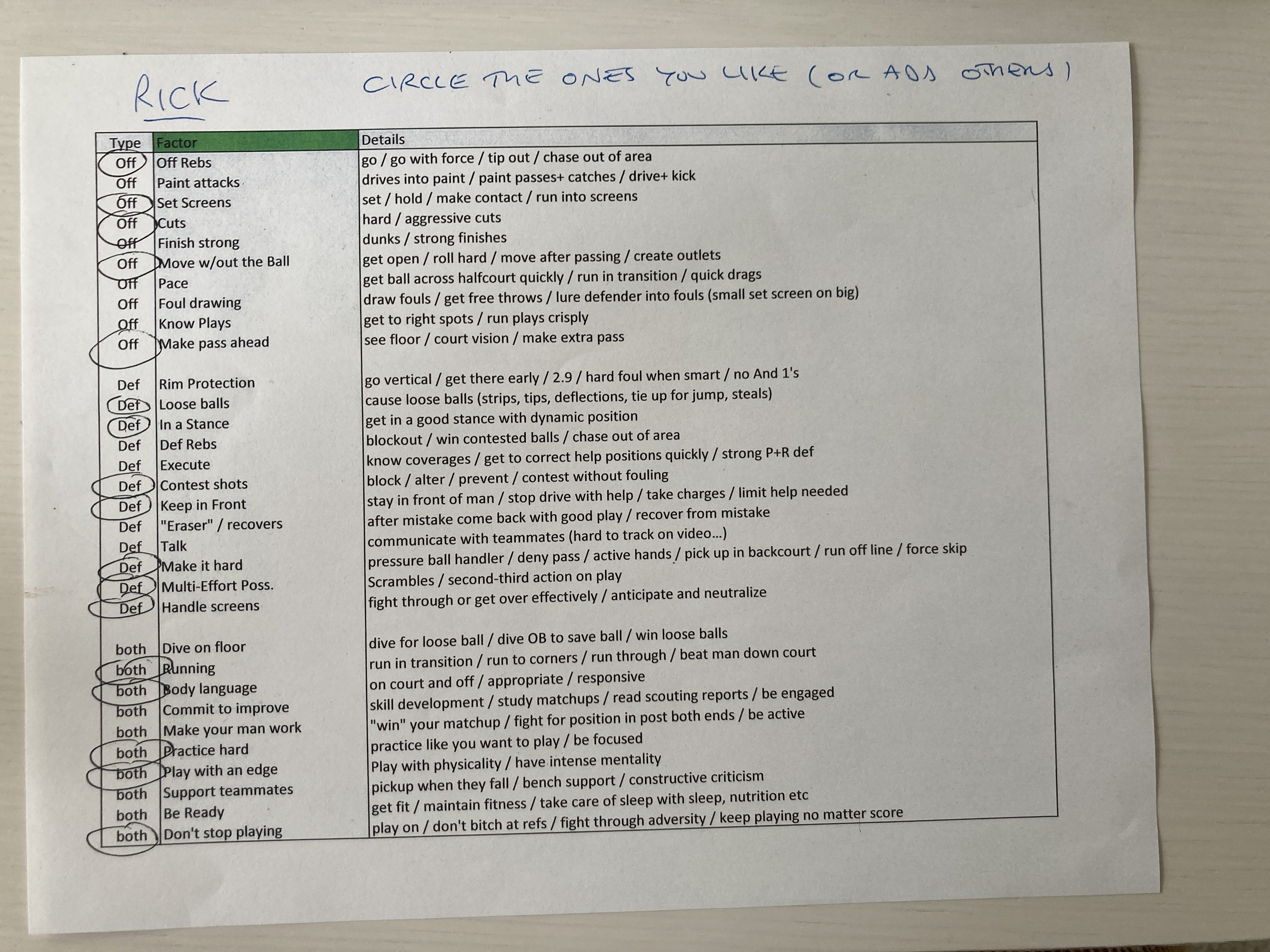
Since the 2024 playoffs, Beech has been hand-charting that data for 82games.com, a revolutionary statistical outpost that helped him land the job with the Mavericks in the first place. Beech, now a Silicon Valley tech consultant who hasn't closed the door on working for an NBA team again, typically spends four hours hand-charting each playoff game, but high-intensity feuds, like the ones we're seeing in the NBA Finals, have taken longer.
With Wembanyama's physicality becoming a focal point in the series as he faces a potential suspension, I asked Beech to run the numbers on the Spurs big man.
The conclusion? Wembanyama was by far the most "physical" player of the NBA Finals — until the elbow in Game 4. After that, Wembanyama didn't play with nearly as much force, and the Spurs let the 29-point lead slip away.
Whether it's due to fatigue or fear of suspension, Wembanyama wasn't the same player before and after the whistle. Two of the top measures that Beech tracks are "Physicality Net Wins" and "Playing Hard Wins." Physicality wins include any head-to-head interaction with contact that has a decisive event (boxing out, screening, shouldering a player on a drive, etc.). When a player logs more physicality wins than his opponent on those interactions that would be a positive "Physicality Net Win," and a negative figure if he tallies fewer. A "Playing Hard Win" would include instances of notable non-contact movement (sprinting toward a loose ball, cutting to the rim, jumping for rebound, etc.).
According to Beech's tracking, Wembanyama, in 24 minutes up until the flagrant call in Game 4, was a plus-7 in "Physicality Net Wins" and had registered 20 of what he calls "Playing Hard Wins." He was winning those battles. After the flagrant, in a 20-minute span of action, Wembanyama's ledger flipped the other way, tallying minus-5 "Physicality Net Wins" and just 11 "Playing Hard Wins."
"Definitely seemed a lot more passive," Beech emailed Yahoo Sports. "I think the flagrant did rattle him a bit."
One particular sequence of plays stood out to Beech while he tracked the game. Late in the third quarter, OG Anunoby decked Wembanyama in the paint as the Spurs center tried to roll to the rim. On the ensuing offensive rebounds, instead of remaining in the basket area and muscling with the Knicks' interior defenders, Wembanyama retreated to the perimeter. There, he took a pair of 3-pointers on Mitchell Robinson instead of driving or pounding the paint. Neither cashed.
Throughout the second half, Beech also noted Wembanyama was unusually absent at the rim and did so enough that he lost his overall head-to-head battles with Towns (minus-5 in H2H physicality), Jalen Brunson (minus-3) and Anunoby (minus-2). In other words, the DPOY winner was getting pushed around.
And that typically hasn't been the case in this series. Beech's tracking shows that Wembanyama on the whole has been the single-most physical player in this series. He has doled out more bumps and grabs (plus-12) than any other player and won the overall battle at the rim, earning a plus-25 figure in that category. He also leads all players in the NBA Finals in "Playing Hard" score, anchored by his monstrous 10.33 rim deters per 36 minutes.
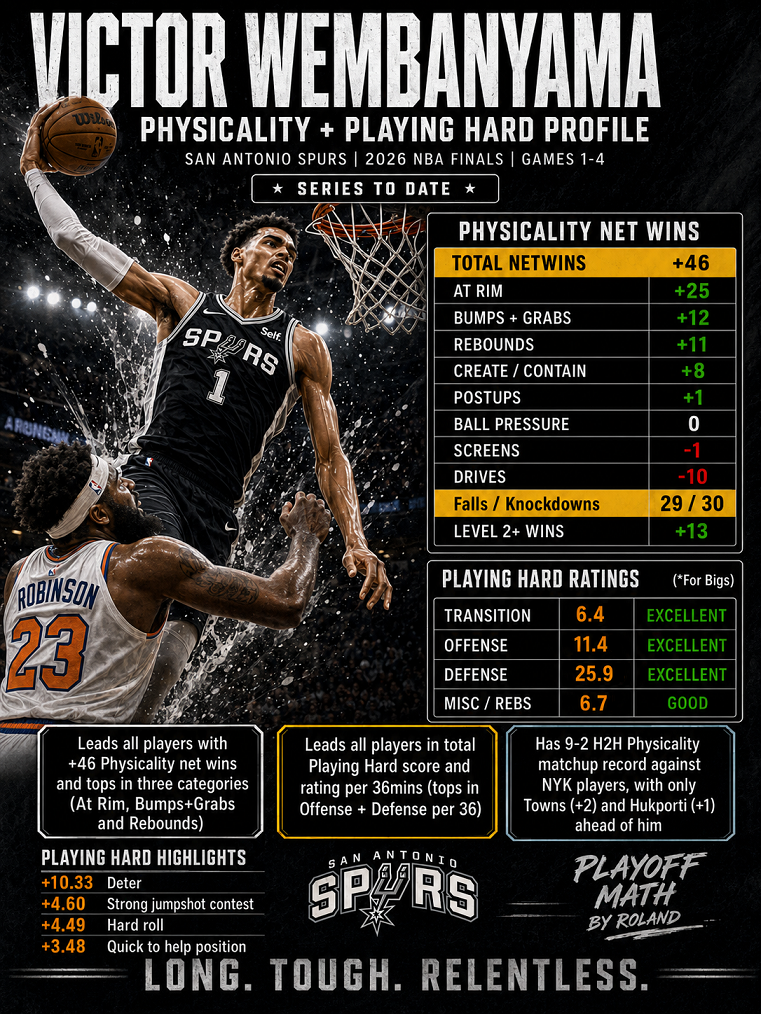
The optical tracking cameras the NBA utilizes in every arena would automate much of what Beech does by hand, but his years working in the league and championship experience has informed Beech to identify which variables hold meaning.
After games, coaches and players talk ad nauseam about the importance of physicality, but it's hardly tracked in the public domain. Without Beech's data, pundits can only point to statistics like free throws, rebounds and blocks as proxies for physicality, and they only go so far.
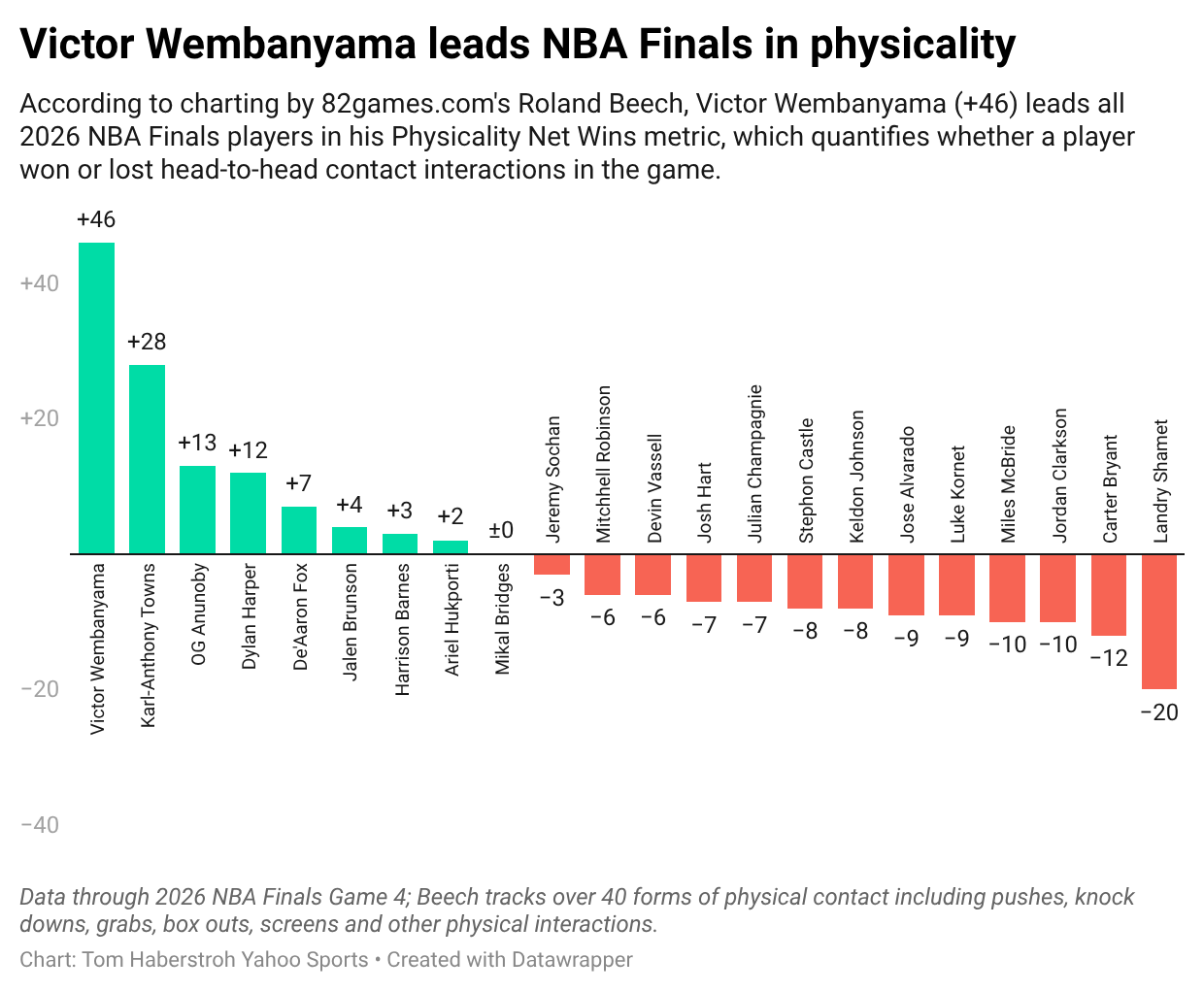
Beech is a firm believer that physicality remains one of the most predictive variables of wins and losses. As of Friday, he has tracked over half of this year's playoff games, and the results are astounding. Beech estimates that, this postseason, the team that wins in his physicality measure has won approximately 80% of its games. His "Playing Hard" score shows an even stronger relationship, with 88% of the teams who play harder than their opponent, by his multi-level measure, winning the game.
In Beech's view, if the public could follow these "intangibles," the Knicks' historic run, the Spurs' rise and the Indiana Pacers' Cinderella run last year would all be less of a surprise.
Like the entire basketball universe, Beech is eager to see which version of Wembanyama emerges in Game 5. He thinks Wembanyama's flagrant point situation could affect his approach in the win-or-go-home matchup. Scoring is one thing, but exerting his impact on the defensive end will draw Beech's focus on Saturday.
"Wemby's defensive force is something that the league is going to have to reckon with for years to come," Beech wrote.
For Wembanyama, the long term will have to wait. Game 5 is all that matters now. With Wembanyama and the Spurs' backs against the wall, the series will be largely dictated by Wembanyama's ability to play with the utmost level of physicality — within league rules.

